
Android Camera Framework & HAL
Modern Android devices rely on a complex software stack to turn camera hardware into the imaging experience users interact with every day. From the image sensor and ISP to the camera application, multiple software layers work together to capture, process, and deliver images.
The Android Camera Framework and Hardware Abstraction Layer (HAL) are key components of this system. Understanding how they work together is important when developing or integrating custom camera hardware on Android platforms.
What Is the Android Camera Framework?
The Android Camera Framework provides the software interfaces that allow applications to interact with camera hardware.
When an application requests a preview, image, or video, the framework manages communication between the application and the underlying camera hardware.
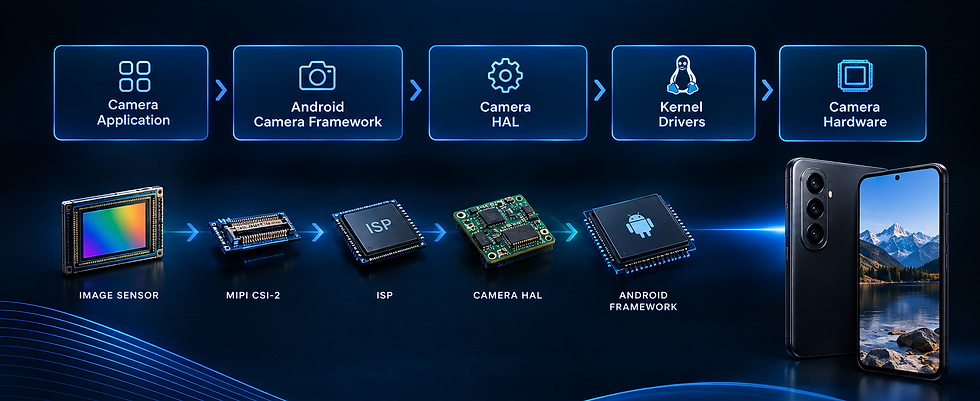
The camera stack can be simplified as:
Camera Application → Camera Framework → Camera HAL → Kernel Drivers → Camera Hardware
This layered architecture allows applications to use cameras without needing to directly manage the hardware.
What Is the Camera HAL?
The Hardware Abstraction Layer (HAL) provides the interface between the Android camera framework and the underlying hardware.
The HAL handles hardware-specific functionality while presenting a standardized interface to the Android framework.
Depending on the platform and Android version, camera HAL implementations may use different interfaces, but their primary purpose remains the same: translating Android camera requests into operations that the hardware can perform.
Camera HAL responsibilities can include:
-
Camera sensor configuration
-
Stream configuration
-
Exposure and gain control
-
Focus control
-
Image capture
-
Buffer management
-
Camera metadata
-
Hardware synchronization
-
Interaction with the ISP
Android Camera HAL3
Modern Android devices primarily use the Camera HAL3 architecture.
HAL3 is designed around a request-based model. The framework sends capture requests to the HAL, specifying parameters such as the desired output streams and capture settings.
The HAL then communicates with the camera hardware and returns the requested image buffers along with metadata.
This architecture provides greater control over the imaging pipeline and supports advanced camera features such as multiple streams, manual controls, and computational photography.
The Camera Pipeline
A typical Android camera pipeline may look like:
Image Sensor → MIPI CSI-2 → ISP → Camera HAL → Android Camera Framework → Application
The exact architecture varies by SoC and camera platform.
The image sensor captures raw data, which is transferred to the processor through an interface such as MIPI CSI-2. The ISP can then perform operations such as demosaicing, noise reduction, HDR processing, white balance, and color correction.
The Camera HAL connects this hardware pipeline to Android's camera software stack.
Camera HAL and Sensor Integration
Integrating a new camera sensor into an Android product requires more than physically connecting the sensor.
The sensor must be properly configured and supported throughout the software stack.
This can involve:
-
Sensor driver development
-
Device tree configuration
-
I2C communication
-
MIPI CSI-2 configuration
-
Resolution and frame-rate configuration
-
Exposure and gain controls
-
Pixel formats
-
ISP configuration
-
Camera metadata
-
HAL integration
Proper coordination between the sensor driver, ISP, HAL, and Android framework is essential for reliable camera operation.
Camera Streams and Buffers
Android camera applications may require multiple outputs from the same camera.
For example, a device may simultaneously need:
-
Preview frames
-
High-resolution still images
-
Video frames
-
AI or computer vision frames
The Camera HAL is responsible for helping configure these streams and managing the buffers used to move image data through the system.
Efficient buffer management is especially important for high-resolution cameras and systems that process multiple streams simultaneously.
Why Camera HAL Development Matters
A camera sensor can meet its electrical and optical requirements while still producing poor results if the software integration is not properly implemented.
Camera HAL development can affect:
-
Image quality
-
Camera responsiveness
-
Frame rate
-
Latency
-
Power consumption
-
Multi-camera operation
-
Feature support
-
Overall system stability
For custom camera hardware, the HAL provides an important connection between the physical imaging system and the Android software environment.
Android Camera Integration Challenges
Camera integration can become increasingly complex when products include multiple sensors, custom ISPs, AI processing, or specialized imaging requirements.
Common challenges include:
-
Integrating new image sensors
-
Supporting multiple camera streams
-
Managing synchronization
-
Configuring ISP processing
-
Maintaining consistent camera metadata
-
Optimizing memory and bandwidth
-
Reducing latency
-
Supporting different Android versions
These challenges require hardware and software teams to work closely together throughout development.
Conclusion
The Android Camera Framework and Camera HAL form an important bridge between camera hardware and Android applications.
By providing a standardized software interface while allowing hardware-specific implementation underneath, the camera stack enables manufacturers and developers to integrate sensors, ISPs, and custom imaging systems into Android products.
For custom camera and embedded vision products, understanding the complete pipeline—from sensor and hardware drivers through the Camera HAL and Android Framework—is essential for achieving reliable performance and image quality.
InnoWave provides embedded software and hardware engineering services for camera and vision products, including camera integration, sensor drivers, ISP tuning, and embedded platform development.
Successful Android camera integration requires close coordination between the sensor, camera drivers, ISP, Camera HAL, and Android framework to deliver reliable image quality and performance. Explore our hardware design services to learn how we support custom camera integration, sensor driver development, ISP development and tuning, Android camera integration, and complete embedded vision hardware development.